
A seed funding round checklist is a structured list of documents, tasks, and validations that startup founders must complete before and during a seed round to improve fundraising success. Most founders underestimate how much preparation drives investor confidence. The checklist covers everything from your pitch deck and cap table to term sheet components, due diligence documents, and investor outreach strategy. Getting this right before your first investor meeting separates founders who close in weeks from those who stall for months.
1. What goes on a seed funding round checklist?
The core of any seed investment checklist is documentation readiness. Investors form their first impression from what you send them, and disorganized materials signal operational immaturity. A standardized data room containing your pitch deck, executive summary, financial model, cap table, SAFE template, incorporation docs, IP assignments, and customer contracts saves weeks during diligence and impresses investors.

Your checklist should be organized into three layers: materials you prepare before outreach, materials you share at first serious investor interest, and materials you finalize at term sheet stage. Each layer has a different audience and purpose. Mixing them up wastes everyone's time.
Pre-outreach materials:
- Pitch deck: 10–12 slides, updated monthly, with a clear problem, solution, traction, and ask
- Executive summary: a 2-page written overview for investors who prefer text before slides
- Financial model: 24-month projections with clearly labeled assumptions
- Cap table: current ownership percentages, any outstanding SAFEs, and your option pool size
Due diligence materials (share at first serious interest):
- Incorporation documents and certificate of good standing
- Founder vesting schedules and shareholder agreements
- IP assignment agreements from all founders and contractors
- Key customer contracts or letters of intent
- Team bios and LinkedIn profiles for core hires
Pro Tip: Use an AI-indexed data room tool like Peony to auto-categorize your documents. Investors who can find what they need in under 5 minutes are far more likely to stay engaged.
2. How to identify and target the right investors
Investor targeting is not a numbers game. Sending your deck to 500 random contacts produces worse results than a focused list of 50–80 investors who match your sector, stage, and check size. Typical seed rounds require a target list of 50–80 investors and a 3–6 month overall timeline. That range reflects real outreach cycles, not optimistic projections.
Build your list in tiers. Tier 1 includes investors with a direct track record in your sector. Tier 2 includes generalist seed funds and angels who have backed adjacent categories. Tier 3 is your warm introduction pipeline, where a mutual connection can open a door that a cold email cannot.
- Define your investor profile: check size ($250,000–$1,000,000 for most seed rounds), sector focus, and geography
- Use Verabro's investor database and AngelList to build your initial list
- Map warm introduction paths through LinkedIn, accelerator networks, and portfolio founders
- Prioritize investors who have led or co-led rounds in your category within the past 24 months
- Track every outreach attempt, follow-up, and response in a CRM or spreadsheet
Pro Tip: Ask portfolio founders from your target funds for a direct introduction. A warm intro from a founder they already backed converts at a significantly higher rate than any cold outreach.
3. What are the key due diligence and compliance steps?
Due diligence is where many seed rounds slow down or die. Investors ask for documents that founders have not prepared, and the back-and-forth erodes momentum. The fix is simple: prepare everything before you start outreach, not after you get interest.
Term sheet economic terms include pre-money valuation, investment amount, liquidation preference, dividends, and anti-dilution provisions. Control terms cover board composition, veto protections, drag-along rights, and pro rata rights. Founders who understand these terms negotiate better outcomes. Reading a term sheet breakdown before your first investor meeting is not optional.
Due diligence checklist:
- Confirm your legal entity is properly incorporated (Delaware C-Corp for US-based startups targeting VCs)
- Verify all founder equity is subject to a 4-year vesting schedule with a 1-year cliff
- Confirm all IP is assigned to the company, not held personally by founders
- Prepare a clean cap table showing fully diluted ownership, including SAFEs and options
- Have signed customer contracts or pilot agreements ready to share
- Prepare a one-page summary of key financial metrics: MRR, burn rate, runway, and growth rate
For Indian founders pursuing government funding, the Startup India Seed Fund Scheme has strict eligibility criteria. Your company must have DPIIT recognition, be incorporated less than 2 years ago, have Indian promoters holding over 51% of shares, and have received less than ₹10 lakh in prior government funding. Applications go through approved incubators, not directly to the government.
| Compliance item | Requirement |
|---|---|
| DPIIT recognition | Required for SISFS eligibility |
| Incorporation age | Less than 2 years at time of application |
| Indian promoter stake | Over 51% shareholding |
| Prior government funding | Less than ₹10 lakh received |
| Application channel | Through approved incubators only |
4. How to budget and plan your fundraising timeline
Fundraising costs money before it makes money. Most founders underestimate legal fees and the time cost of managing investor conversations in parallel. Planning your budget upfront prevents surprises mid-round.
SAFEs cost $2,000–$5,000 in legal fees and close in 1–2 weeks. Priced rounds with full term sheets cost $15,000–$30,000 and take 4–8 weeks. For rounds under $3 million, SAFEs are the faster and cheaper path. That cost difference is not trivial for a pre-revenue startup managing a tight runway.
Fundraising budget checklist:
- Legal fees: budget $2,000–$5,000 for SAFE-based rounds or $15,000–$30,000 for priced rounds
- Data room tools: allocate for a professional platform rather than a shared Google Drive folder
- Travel and meetings: budget for in-person investor meetings, especially for Tier 1 targets
- Accounting: prepare clean financial statements before outreach, not during diligence
- Time cost: plan for 3–6 months of active fundraising alongside running your company
Pro Tip: Start preparing your documents 60 days before you plan to begin outreach. Founders who enter conversations with everything ready close significantly faster than those who build materials on the fly.
5. What is the right document sharing and communication strategy?
Investor communication is a process, not a series of one-off emails. The goal is to maintain momentum from first contact through wire transfer. Losing momentum at any stage means starting over with a cold investor.
Founders who share data room access promptly after an investor expresses serious interest prevent delays in due diligence and shorten closing times. Proactively sharing documents correlates with faster investment decisions and fewer follow-up requests. Waiting to share materials until an investor asks twice signals disorganization.
Communication and sharing checklist:
- Send your pitch deck within 24 hours of a positive first meeting
- Grant data room access immediately when an investor signals serious interest
- Use a platform with document analytics so you know which investors have opened your materials
- Respond to document requests within 48 hours to maintain deal momentum
- Use e-signatures (DocuSign or Dropbox Sign) for term sheet acceptance to avoid delays
- Send a brief weekly update to active investors during the closing process
Pro Tip: Never share your full data room in a cold email. Reserve it for investors who have expressed genuine interest after an initial conversation. This keeps your materials exclusive and signals that access is earned.
6. How seed rounds close faster with the right preparation
Most seed rounds close in 4–6 weeks after initial investor interest when all documentation, including the pitch deck, financials, and cap table, is ready and shared proactively. That timeline assumes no surprises in diligence. Founders with AI-indexed data rooms who share documents at first investor interest close faster than those who scramble to compile materials after receiving interest.
The difference between a 6-week close and a 6-month close is almost always preparation, not investor appetite. Investors are ready to move when founders are ready to move. Your job is to remove every friction point from their decision process.
Key Takeaways
A complete seed funding round checklist covering documents, investor targeting, due diligence, and budget planning is the single most reliable way to shorten your fundraising timeline and increase investor confidence.
| Point | Details |
|---|---|
| Document readiness first | Prepare your pitch deck, cap table, and data room before starting any investor outreach. |
| Target 50–80 investors | A focused, tiered list outperforms broad, untargeted outreach every time. |
| Choose SAFEs for speed | SAFEs cost $2,000–$5,000 and close in 1–2 weeks versus $15,000–$30,000 for priced rounds. |
| Share documents proactively | Granting data room access at first serious interest shortens closing times measurably. |
| Budget 3–6 months | Realistic timeline planning prevents runway surprises during an active fundraise. |
What I have learned from watching founders prepare for seed rounds
The most common mistake I see is founders treating the checklist as something to complete during the fundraise rather than before it. They get a warm introduction, the investor asks for the cap table, and suddenly three days pass while the founder scrambles to clean up a spreadsheet. That delay costs more than time. It signals to the investor that the business may be equally disorganized.
The second mistake is sharing a Google Drive folder with 47 unorganized files and calling it a data room. Investors who open a messy folder close the tab. A clean, AI-indexed data room tells investors that you run a tight operation before they have read a single document.
My honest advice: start your checklist 60 days before you plan to send your first pitch. Use SAFEs unless you have a specific reason to run a priced round. Keep your term sheet language founder-friendly but precise. And do not wait for your documents to be perfect before starting outreach. A 90% ready deck with a warm introduction beats a perfect deck sent cold every time.
The founders who close seed rounds efficiently are not always the ones with the best product. They are the ones who make it easy for investors to say yes.
— Andres
Verabro helps you find and reach the right seed investors
Building a targeted investor list from scratch takes weeks. Verabro gives you access to over 15,000 verified investors, with AI-driven matching that filters by sector, stage, and check size so you reach the right people first.
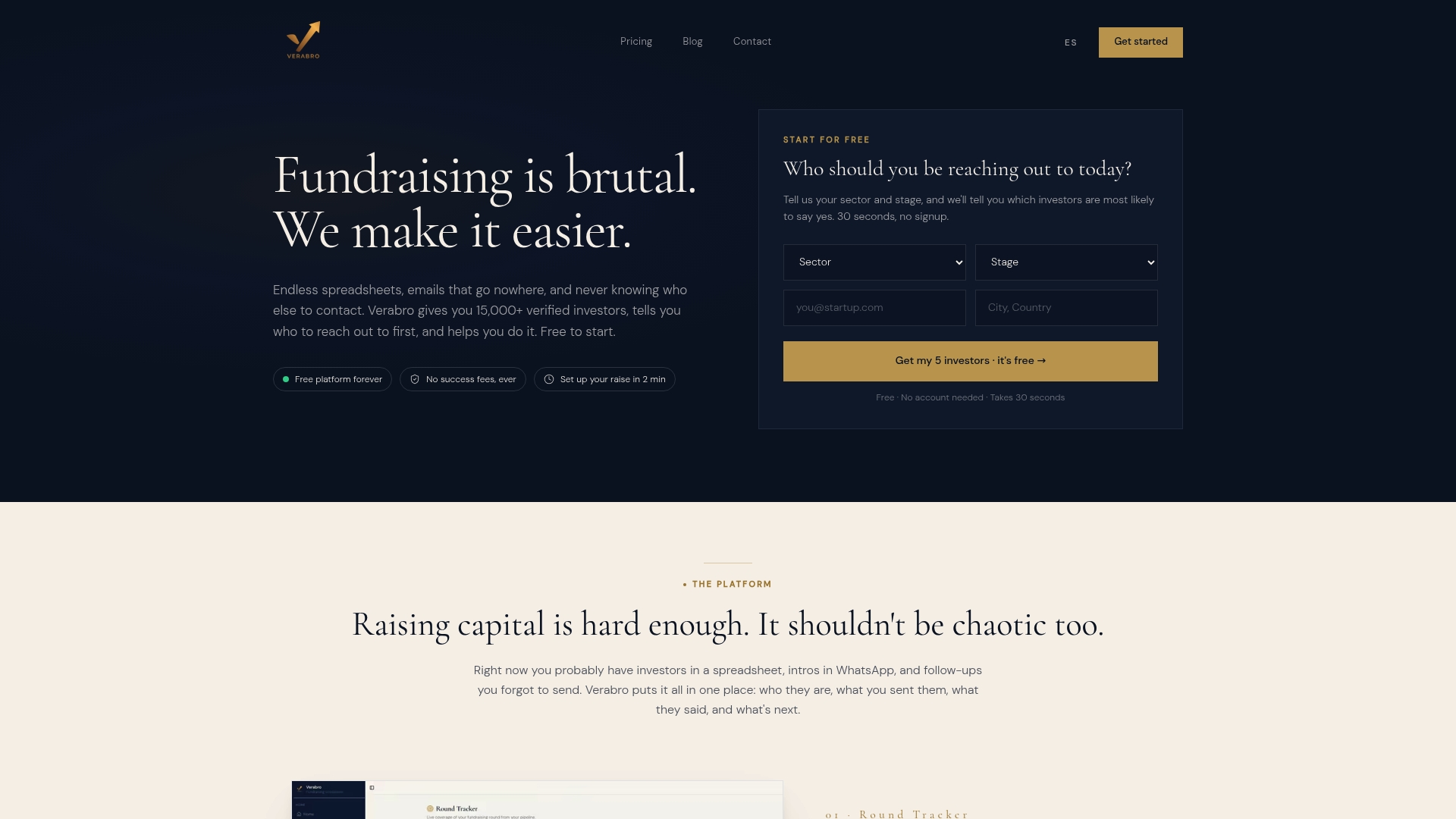
Verabro's Round Tracker shows you exactly where each investor stands in your pipeline, so you never lose momentum between conversations. The platform is free forever with no success fees, which means you manage your entire fundraising pipeline without financial pressure. For founders who want a faster, more organized raise, Verabro is the practical starting point. You can also explore the startup investor database to begin building your target list today.
FAQ
What documents are required for a seed funding round?
The core seed funding documents required include a pitch deck, executive summary, financial model with 24-month projections, cap table, SAFE or term sheet template, incorporation papers, IP assignments, and key customer contracts.
How long does a seed funding round take to close?
Most seed rounds close in 4–6 weeks after initial investor interest when all documentation is prepared and shared proactively. Without ready materials, the timeline extends to 3–6 months.
What are the seed funding eligibility criteria for Startup India?
The Startup India Seed Fund Scheme requires DPIIT recognition, incorporation less than 2 years old, Indian promoters holding over 51%, and less than ₹10 lakh in prior government funding. Applications are submitted through approved incubators.
Should I use a SAFE or a priced round for my seed raise?
SAFEs are the better choice for rounds under $3 million because they cost $2,000–$5,000 in legal fees and close in 1–2 weeks. Priced rounds cost $15,000–$30,000 and take 4–8 weeks to close.
How many investors should I target in a seed round?
A focused list of 50–80 investors is the recommended size for a seed round. This range balances enough pipeline to create competition with enough focus to personalize your outreach effectively.