
Locating investors matching your startup stage means identifying those who actively write checks at your specific development phase, check size, and sector. Most founders waste weeks pitching investors who simply do not fund their stage. The industry term for this process is "investor targeting," and it combines database research, precise filtering, and personalized outreach. Tools like Crunchbase, AngelList, and OpenVC make this targeting possible, and AI-powered platforms are now making it faster. This guide walks you through every step, from categorizing your stage to building a curated list of investors who are genuinely likely to engage.
How to locate investors matching your startup stage
Investor targeting starts with one question: what stage are you actually at? The answer determines which investors belong on your list and which do not. Pitching a Series A fund when you have no revenue wastes your time and theirs.
The three most common stages are pre-seed, seed, and Series A and beyond. Each has distinct characteristics.
- Pre-seed: You have a founding team, an idea, and possibly an early prototype. Revenue is typically zero. Check sizes from investors at this stage usually run under $1 million. Angel investors, micro-VCs, and specialized pre-seed funds are your primary targets.
- Seed: You have a working product, early traction, and some user data. Check sizes typically range from $500,000 to $3 million. Seed-focused VCs and larger angel syndicates are active here.
- Series A and beyond: You have proven product-market fit, measurable revenue growth, and a team of 10 or more. Institutional VCs writing checks of $5 million and above are the right audience.
Investors focus on specific stages for structural reasons. A pre-seed fund raises a small fund and cannot deploy $10 million into a single deal. A Series A fund cannot justify the due diligence cost on a $200,000 check. Matching your stage to their fund size is not optional. It is the baseline filter that determines whether your email gets read.
Pro Tip: If you are between stages, describe yourself by the stage you are entering, not the one you are leaving. Investors fund where you are going, not where you have been.

What are the best platforms to find investors by stage?
Top platforms to find investors include Crunchbase, AngelList, OpenVC, and AI-powered matching tools that generate fit scores based on your sector and stage. Each platform has different strengths, and the best founders use more than one.
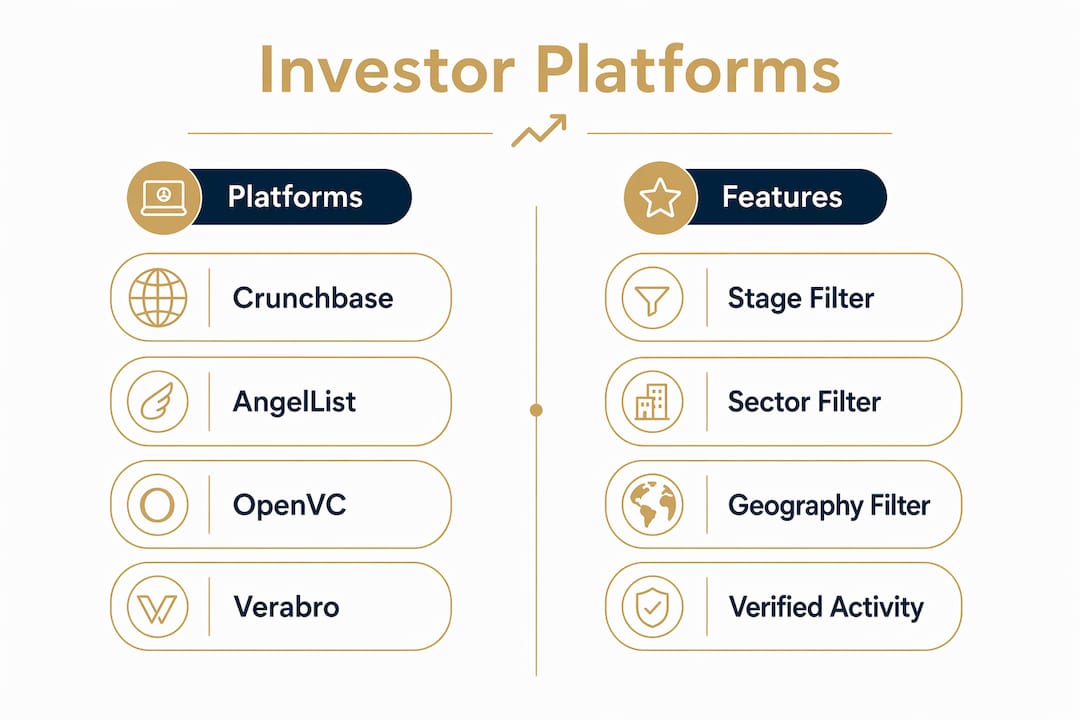
| Platform | Stage filter | Sector filter | Geography filter | Verified activity |
|---|---|---|---|---|
| Crunchbase | Yes | Yes | Yes | Partial |
| AngelList | Yes | Yes | Limited | Partial |
| OpenVC | Yes | Yes | Yes | Yes |
| Verabro | Yes | Yes | Yes | Yes (15,000+ investors) |
Crunchbase is the most widely used investor database. Its strength is breadth: you can filter by funding stage, sector, and geography, and then cross-reference a fund's recent portfolio to check activity. AngelList is strongest for pre-seed and seed, where angel syndicates and rolling funds are most active. OpenVC focuses specifically on early-stage startups and publishes investor theses directly, so you can read exactly what a fund wants before reaching out.
AI-powered investor matching cuts prospecting time and improves results by scoring your startup's fit against investor profiles using detailed data points. That means less time scrolling through lists and more time talking to investors who are already predisposed to your category.
Investors concentrate on sectors and geographies they know, so matching sector and location is as important as matching stage. A fintech fund in New York is unlikely to lead a round for a climate hardware startup in Berlin, regardless of how strong your metrics are. Always apply all four filters: stage, sector, geography, and check size.
Pro Tip: Check the "recent investments" tab on Crunchbase for any fund you are considering. If their last deal was over 18 months ago, move them to a lower-priority tier.
How to build a targeted investor list step by step
A targeted investor list is the foundation of any efficient fundraise. Here is the process that works.
-
Define your four criteria. Write down your stage, primary sector, geography, and the check size you need. Be specific. "Seed-stage B2B SaaS, $500,000 to $1.5 million check, US or Europe" is a usable filter. "Tech startup looking for funding" is not.
-
Run your filters on two or three platforms. Start with Crunchbase and OpenVC. Export or save every investor who matches all four criteria. Aim for a raw list of 150 to 200 names before you start cutting.
-
Verify recent activity. Active investor engagement is best determined by their recent history of financings, not only website claims. Remove any investor whose last deal at your stage was more than 12 months ago. This single filter eliminates a large portion of stale leads.
-
Prioritize by portfolio fit. Look for investors who have already backed one or two companies similar to yours, but not direct competitors. That portfolio fit signals sector knowledge and a higher likelihood of engagement.
-
Identify warm introduction paths. Check LinkedIn and your existing network for second-degree connections to each investor. A warm introduction converts at a significantly higher rate than a cold email.
-
Segment your list into tiers. Tier 1 is your top 20 to 30 investors, where you will invest the most personalization. Tier 2 is the next 50. Tier 3 is everyone else. Personalized outreach to 20–30 investors from a curated, stage-aligned list statistically increases meeting success rates compared to mass outreach.
-
Track every interaction. Tracking investor engagement systematically increases raise success and conserves runway. Use a CRM or a dedicated fundraising tracker to log every email sent, every reply, and every meeting scheduled.
What are the most common mistakes when targeting investors?
The most common mistake is pitching investors outside your stage and check size. Startups fail to fundraise mostly because founders pitch wrong-stage investors with mismatched check sizes. A $50 million fund writing $5 million minimum checks will not lead your $750,000 pre-seed round, no matter how compelling your pitch is.
Here are the other mistakes that cost founders the most time:
- Using stale databases. Investor profiles on generic directories often go years without updates. An investor listed as "active in SaaS seed" may have shifted focus to growth equity or paused investing entirely.
- Ignoring specialized funds. Founders often miss 100+ active specialized pre-seed funds by fixating on household-name VCs. These smaller, focused funds write checks consistently and are far more accessible to first-time founders.
- Skipping geography filters. Many funds have geographic mandates written into their LP agreements. Pitching a fund that only invests in the US when you are incorporated in Southeast Asia is a structural mismatch.
- Treating all investors as interchangeable. Each fund has a thesis. Sending the same generic pitch to 200 investors signals that you have not done the work.
"Effective fundraising requires up-to-date targeting based on recent investment patterns rather than outdated investor profiles." — 10,000+ Investors, Pre-seed to Series A+, Zero Guesswork
The fix for all of these mistakes is the same: build your list from verified, recent data and apply all four filters before you write a single outreach email. You can also review Crunchbase alternatives that offer more up-to-date investor activity data for early-stage searches.
Key Takeaways
Founders who target investors by stage, sector, geography, and check size, and who verify recent activity before outreach, raise capital faster and waste less runway.
| Point | Details |
|---|---|
| Stage matching is non-negotiable | Pitch only investors whose fund size and check range align with your current stage. |
| Verify activity within 12 months | Remove any investor from your list who has not made a deal at your stage in the past year. |
| Specialized funds are underused | Over 100 active pre-seed funds write consistent checks but are overlooked by most founders. |
| Personalized outreach wins | A curated list of 20–30 stage-matched investors outperforms mass outreach to hundreds. |
| Track every interaction | A CRM or fundraising tracker keeps your pipeline organized and your timing sharp. |
Why most founders are targeting the wrong investors
The founders I see struggle most with fundraising are not struggling because their startup is weak. They are struggling because they are pitching the wrong people. A great seed-stage SaaS company pitching a growth equity fund is not a fundraising problem. It is a targeting problem.
The most underrated shift a founder can make is moving attention away from the top 10 brand-name VCs and toward the 100-plus active specialized funds that write checks every quarter with far less competition for their attention. These funds are not hiding. They publish their theses on OpenVC, they post on LinkedIn, and they respond to well-researched cold emails. The barrier is not access. It is the work of finding them and personalizing your approach.
I also want to push back on the idea that a bigger list is a better list. Sending 500 cold emails is not a fundraising strategy. It is a way to burn your reputation with investors you might want to approach again in a later round. A list of 80 well-researched, stage-matched investors, worked methodically with personalized outreach, will outperform a spray-and-pray approach every time.
Finally, update your list continuously. Investor focus shifts. Funds go quiet after a new raise, then become very active again. The founder who checks in on their investor list every 30 days is always working with current data. The one who built a list in January and never touched it again is pitching into a void.
— Andres
How Verabro helps you find the right investors faster
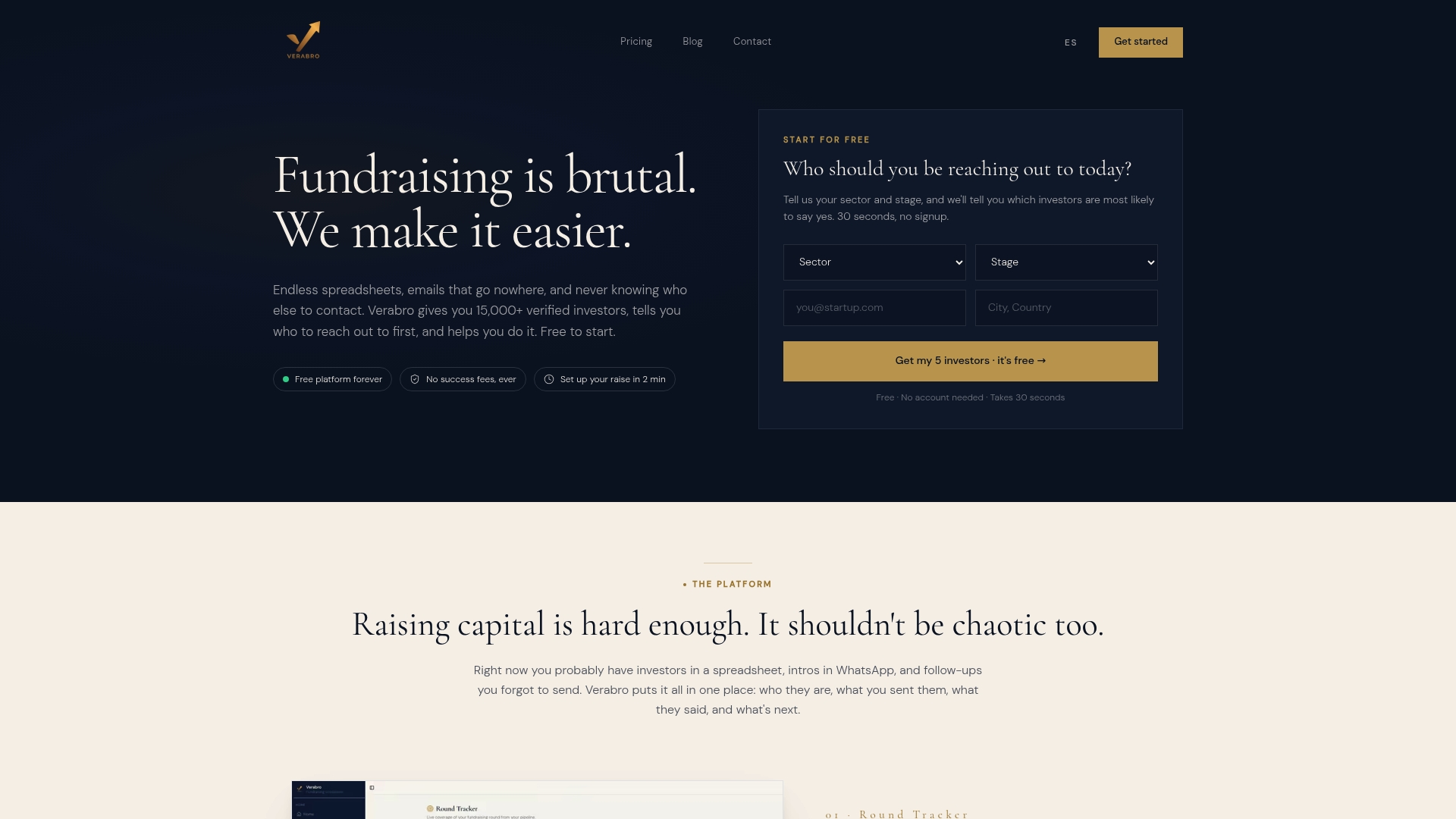
Verabro gives founders direct access to over 15,000 verified investors for startups, all filterable by stage, sector, geography, and check size. The platform's AI-driven matching feature analyzes your specific sector and stage, then ranks investors by their likelihood to engage, so your Tier 1 list is built for you rather than assembled manually. Verabro also includes a Round Tracker that shows your fundraising progress in real time, and a built-in CRM so every investor interaction is logged in one place. The platform runs on a free forever model with no success fees. You can start building your investor list today without any upfront cost.
FAQ
What does "investor stage matching" mean?
Investor stage matching means identifying investors whose fund size, check range, and sector focus align with your startup's current development phase. Pitching outside that match is the leading reason founders fail to close rounds.
How do I know if an investor is still active?
Check their portfolio for deals made within the last 12 months at your stage. Recent investment history is a more reliable signal of activity than an investor's website or bio.
What are the best investor databases for pre-seed startups?
OpenVC, Crunchbase, AngelList, and Verabro are the top choices for pre-seed investor databases. Each allows filtering by stage and sector, and Verabro adds AI-based fit scoring across 15,000 verified investors.
How many investors should I target at once?
Focus your personalized outreach on 20–30 stage-matched investors at a time. Expanding to a broader list of 100 is reasonable for initial research, but concentrated, personalized outreach consistently outperforms mass campaigns.
What filters matter most when searching for investors?
Stage, check size, sector, and geography are the four filters that determine investor fit. Applying all four before outreach removes the majority of mismatched leads and saves significant time.